
Foreign ownership of property in Thailand: what you can and cannot own
Foreigners can own condominium units freehold, as long as the building stays within its 49% foreign-ownership quota of total floor area. Foreigners cannot own land outright; the legal routes are a registered 30-year lease, a usufruct or superficies, owning the building while leasing the land, or — with care — a properly run Thai company. Each route is legal and safe when documented correctly; the danger is the illegal nominee shortcut.
What foreigners can and cannot own
Thai law draws a sharp line between buildings (which a foreigner can own) and land (which, with narrow exceptions, a foreigner cannot own outright). Understanding that line is the whole game.
- Condominium units — yes, freehold, within the building’s 49% foreign quota.
- The building of a house or villa — yes, you can own the structure outright.
- Land — no freehold for foreigners; you hold it through a lease, usufruct , superficies , or a Thai company.
- Agricultural land — effectively off-limits to foreigners.
So a foreigner can fully own a Phuket condo on a Chanote title, or own a villa while holding the land beneath it on a registered lease . What you cannot do is take a freehold land title in your own name.
Condominium freehold and the 49% quota
The Condominium Act lets foreigners own units outright, but caps total foreign ownership in any one building at 49% of the combined unit floor area. Once a building hits that 49%, remaining units are sold to foreigners on a registered lease instead of freehold.
Practical point: the quota is measured per building, by floor area — not per number of units. Your lawyer can ask the juristic person (building management) for the current figure in writing. Near the 49% line, your unit may only be available on a lease, which changes what you are buying.
Holding land: lease, usufruct, superficies, company
Because you cannot take freehold land, villa and house buyers use one of these routes. They are all legal; the differences are about term, security, and cost.
| Route | What you hold | Max term | Notes |
|---|---|---|---|
| Condominium freehold | The unit itself | No expiry | Within the 49% quota; simplest route |
| Registered lease | The right to use the land + your building | 30 years; renewal not guaranteed | Most villa buyers; courts will not enforce automatic renewal |
| Usufruct | The right to use & enjoy the land | Lifetime (individuals) | Ends on death; not transferable |
| Superficies | The right to own buildings on another’s land | Up to 30 years or lifetime | Often paired with a lease |
| Thai company | Shares in a company that owns the land | — | Must be a genuine business; nominee structures are illegal |
On leasehold, be realistic about the horizon. A registered lease runs up to 30 years and is enforceable for that term, but Thai courts do not enforce a pre-agreed automatic renewal beyond the statutory cap — any extension is a fresh agreement with the landowner at the time. Plan around 30 years, not an assumed roll-over. For an individual buyer who wants a longer horizon, a lifetime usufruct is often the stronger choice.
The Thai-company route is legitimate only when the company is a real, operating business — not a shell created solely to get around the land-ownership ban. That shortcut is the nominee structure , and it is exactly what the 2026 crackdown targets. Enforcement is no longer theoretical: through 2026 the Department of Business Development has been screening company and land records with AI, and since 1 April 2026 it requires in-person verification, ultimate-beneficial-owner checks, and proof of genuine Thai capital — the very things a nominee shell cannot show. If you are weighing a company structure, read our guide on buying safely first and take independent legal advice.
Title-deed types you will encounter
Not every "title" is full ownership. The deed type tells you how strong the claim is and whether it is safe to buy.
| Document | What it means | Safe to buy? |
|---|---|---|
| Chanote (Nor Sor 4 Jor) | Full ownership title, accurately surveyed — the strongest deed | Yes — the gold standard |
| Nor Sor 3 Gor | A confirmed possessory right, near-equivalent to ownership — surveyed, transferable, and upgradable to Chanote | Usually, with proper checks |
| Nor Sor 3 | A right to possess, not precisely surveyed; boundaries can be disputed | Caution — verify carefully |
| Sor Kor 1 / possessory | A notice of possession, not ownership; cannot be freely transferred | Avoid |
For a condo you want a Chanote on the unit; for land, a Chanote or a clean Nor Sor 3 Gor. Whatever the document, confirm it against the Land Office registry before you pay — a deed is only as good as what the registry says.
Which route is right for you
A quick way to narrow it down:
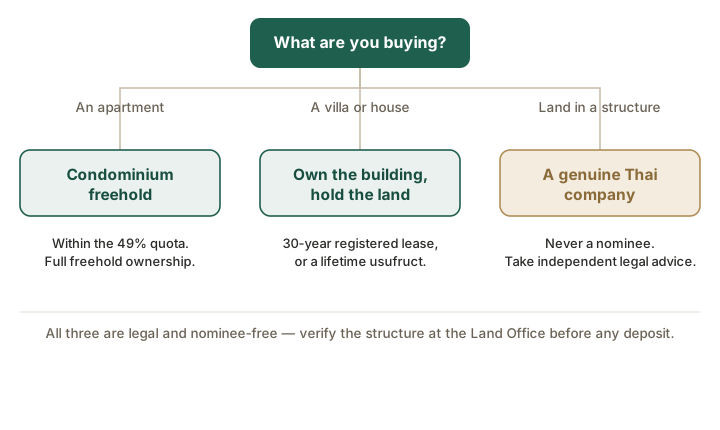
- Buying an apartment? A condominium unit on a Chanote, within the 49% quota, is the cleanest freehold ownership available to you.
- Buying a villa or house? You will own the building; hold the land on a registered 30-year lease, and consider a usufruct or superficies for a longer or stronger personal-use horizon.
- Want the land in a structure? Only through a genuine operating Thai company — never a nominee — and only with independent legal advice.
- Whatever you choose, get the structure written into the sale agreement and verified at the Land Office before any deposit.
Key terms
- Chanote (Nor Sor 4 Jor)
- The strongest Thai title deed — full, accurately surveyed ownership. The document you want for a condo unit, or for land held through a legal structure.
- Nor Sor 3 Gor
- A confirmed possessory right over land — surveyed, transferable, mortgageable, and upgradable to a Chanote. Near-equivalent to ownership.
- Freehold
- Outright ownership of a property with no time limit. Foreigners can own condominium units freehold within the building’s 49% quota, but cannot own land freehold.
- Leasehold
- Holding property under a registered lease rather than owning it. A Thai land lease runs up to 30 years; any renewal beyond that is a fresh agreement, not an enforceable right.
- Usufruct
- A registered right to use and enjoy land you do not own. Granted to an individual, it can last their lifetime; it ends on death and cannot be transferred.
- Superficies
- A registered right to own buildings or structures on land owned by someone else, for up to 30 years or the holder’s lifetime. Often paired with a lease.
- 49% foreign quota
- The cap that lets foreigners collectively own up to 49% of a condominium building’s total unit floor area on a freehold basis. Beyond it, units are sold to foreigners on a registered lease.
- Juristic person
- The legal entity that owns the common areas and runs a condominium building (the management body), distinct from the individual unit owners. Your lawyer asks them for the building’s current foreign-ownership figure.
- Nominee structure
- An illegal arrangement where a Thai person or company holds property on paper for a foreigner who really funds and controls it, to get around the land-ownership rules. The target of the 2026 crackdown.
FAQ
Can a foreigner own land in Thailand?
Not on a freehold title in their own name (outside very narrow exceptions). Foreigners use a registered lease, a usufruct or superficies, or a genuine Thai company to hold land, and can own the building on it outright.
What is the 49% foreign quota?
In any condominium building, foreigners can collectively own up to 49% of the total unit floor area on a freehold basis. Beyond that, units are sold to foreigners on a registered lease. Always check a building’s current figure before reserving.
Will the quota rise to 75%?
It has been discussed as an economic-stimulus proposal, with foreign voting rights kept at 49%, but as of 2026 it is not law. Plan around the current 49% rule.
Can I renew a 30-year lease automatically?
No. A registered lease is enforceable for its term up to 30 years, but Thai courts do not enforce a pre-agreed automatic renewal beyond the cap. Any extension is a new agreement with the landowner at expiry, so plan around the 30-year horizon.
What is a Chanote?
A Chanote (Nor Sor 4 Jor) is the strongest Thai title deed — full, accurately surveyed ownership. It is the document you want for a condo unit, or for land held through a legal structure.
Is freehold or leasehold better?
For a condo, freehold within the quota is best — full ownership, no expiry. For land you cannot take freehold, so a registered lease (or usufruct) is the route; just go in understanding the 30-year horizon rather than assuming perpetual renewal.
Sources & references
- Department of Lands, Thailand (official registry & title deeds)
- Nation Thailand — foreign condominium ownership quota review (2026)
- Nation Thailand — 2026 nominee crackdown and property-law loopholes
- DBD — Department of Business Development (company registry & verification)
- Siam Legal — foreign property ownership in Thailand
- Siam Legal — title-deed (Chanote) search in Thailand
- Genie Property — Thai land title deeds explained (Chanote, Nor Sor 3 Gor, Sor Kor 1)
Not sure which ownership route fits your purchase?
Tell us what you are buying — a condo, a villa, or land — and your timeline. We will reply within one business day to help you plan the right structure and the checks to run before you commit.