
Investing in Phuket property: yields, costs and the honest numbers
Phuket condos let on the short-term market commonly advertise gross rental yields of roughly 6–9% by area, but the net yield — after management, maintenance, fees and tax — is typically several points lower. The investment case rests on that net figure plus tourism-driven occupancy, not the headline gross. Off-plan can be cheaper but carries completion risk, and developer “rental guarantees” are marketing claims to verify, not secured income.
The Phuket investment case — and its honest limits
Phuket pairs two things most rental markets do not have together: year-round international tourism demand and yields well above what the same money buys in most of Europe. A well-located condo on a managed short-let can earn a gross rental yield several times the net yield of a comparable apartment in a major EU city.
That is the case for looking. The discipline is to separate the headline from the take-home. Marketing leads with gross yield; what lands in your account is the net yield after costs, and on a managed Phuket short-let the gap between the two is usually several percentage points. This guide works in net figures.
Rental yields by area
Yields vary by location, property type and how hard the unit is let. The figures below are conservative gross benchmarks drawn from Phuket market sources — a starting point for comparison, not a quote for a specific unit. Beach-and-nightlife areas like Patong run highest on short-let demand; quieter southern areas trade yield for lifestyle and lower entry prices.
| Area | Indicative gross yield (condo) |
|---|---|
| Patong | ~9% |
| Karon | ~8% |
| Bang Tao / Laguna / Cherng Talay | ~7.5% |
| Kata | ~7.5% |
| Kamala | ~7% |
| Surin | ~7% |
| Layan | ~7% |
| Rawai / Nai Harn | ~6.5% |
Villas typically show a lower gross yield than condos in the same area — they cost more per unit and run higher maintenance — but draw larger families and longer stays. Two levers move returns more than the area does: occupancy (a well-run Phuket short-let targets roughly 65–78%, but it is seasonal and never guaranteed) and your management and cost base.
Model it: the rental yield calculator
Enter a price, area and type below. The calculator pulls the sourced gross benchmark for that area, then applies conservative, sourced operating costs to show the net income and net yield — the same engine that powers every property page on the site.
Rental yield calculator — model any Phuket property
Enter a price, area and type to see the gross yield benchmark for that area, then the net figure after the costs that actually eat returns — management, maintenance, fees and tax. This is the same engine behind every property page on the site.
Estimate, not financial advice or a guaranteed return. The gross yield is a sourced area benchmark, not a promise for a specific unit; net income applies conservative, sourced defaults for management (25% of revenue), maintenance, common-area fees, insurance and rental income tax. Your real return depends on the actual property, letting model and costs. Ask Estate Asia →
What eats your yield
The distance between gross and net is real money, and most of it is predictable. Budget for it before you buy, not after.
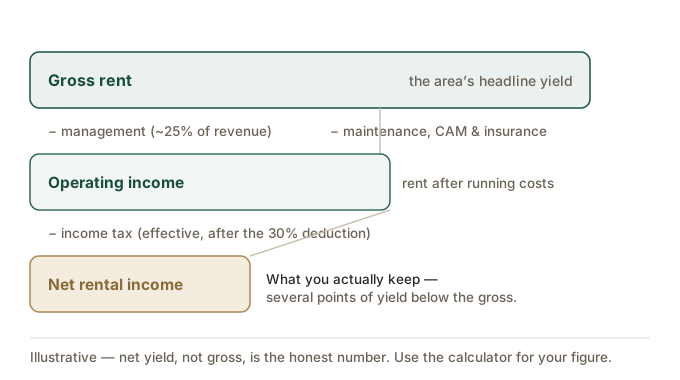
- Rental management — short-term Phuket management commonly runs 20–30% of gross revenue; the calculator defaults to 25%. Self-managing from abroad is rarely realistic.
- Maintenance and a repairs reserve — wear is faster on a let property than an owner-occupied one.
- Common-area (CAM) fees — a monthly per-square-metre charge on condos for the shared facilities; a standing cost whether or not the unit is let.
- Insurance and the annual Land and Building Tax — individually small, but real.
- Income tax on the rent — after a standard 30% deduction the effective rate is modest; the calculator applies a conservative effective rate, and the tax guide covers how Thai rental income tax is worked out.
Then there is the one-time cost of buying: the transfer fee (2% of appraised value, customarily split with the seller), legal and title-check fees, lease registration if you buy leasehold, and the condo sinking fund. The calculator folds these into a “total cash-in” so your payback is measured against what you actually spend, not just the sticker price.
Off-plan vs resale
Buying off-plan — from the plans, before completion — is usually cheaper per square metre and lets you stage payments, but title only transfers on completion, which is a long window in which the developer must actually deliver. A finished resale costs more and offers less choice, but you can see the real unit, the real building, and an actual letting track record.
For off-plan especially, the developer’s legitimacy is the investment. Check the title, the construction permit and EIA where required, and the track record — our developer-verification guide covers how.
Underwrite the downside
A sound Phuket investment survives a soft season. Pressure-test it before you buy:
- Run the calculator at a lower occupancy (say 55–60%), not the optimistic case — if the numbers only work at peak occupancy, they do not work.
- Treat capital appreciation as upside, not the plan; underwrite on rental income you can defend.
- Confirm the building’s foreign-quota headroom and the title with a lawyer before any deposit; never use a nominee structure to get around the land rules.
- Budget the exit: there is no separate capital gains tax for individuals, but the Land Office collects transfer taxes when you sell.
- Use a registered lawyer and pay through proper channels (ideally Escrow ), not a personal account.
Key terms
- Gross rental yield
- Annual rent as a percentage of the purchase price, before any costs. A headline figure useful for comparing areas, but it overstates what you actually keep — net yield is the honest number.
- Net rental yield
- Annual rent after operating costs — management, maintenance, common-area fees, insurance and income tax — as a percentage of the price. On a managed Phuket short-let it is typically several points below the gross yield.
- Occupancy rate
- The share of available nights actually booked over a year. It swings returns more than the nightly rate does; a well-run Phuket short-let targets roughly 65–78%, but it is seasonal and never guaranteed.
- Rental guarantee
- A developer promise to pay a fixed return (e.g. 6–8% a year) for an initial period. It is only as good as the developer’s balance sheet, is often priced into a higher purchase price, and is not a regulated or secured income — treat it as marketing to verify, not a sure thing.
- Capital appreciation
- The rise in a property’s resale value over time, separate from rental income. It is never guaranteed, varies sharply by location and cycle, and in Thailand the cost of realising it is the Land Office transfer taxes at sale.
- Off-plan
- Buying a property before it is built, from the plans. Usually cheaper, but riskier — title only transfers on completion, which is a long window.
FAQ
What rental yield can I expect in Phuket?
Indicative gross yields by area run roughly 6–9% for condos, highest in short-let hotspots like Patong. But gross overstates what you keep — after management, maintenance, fees and tax the net yield is typically several points lower. Use the calculator above to model a specific price and area.
Is Phuket property a good investment in 2026?
It can be, if you underwrite on net rental income at a realistic occupancy rather than the headline gross yield or hoped-for appreciation. The yields are well above most of Europe, but the discipline is to verify the developer, the title and the real costs before you buy.
Should I buy off-plan or a finished property?
Off-plan is usually cheaper and lets you stage payments, but you carry completion risk and only get title on handover. A finished resale costs more but lets you see the actual unit and its letting record. For off-plan, the developer’s legitimacy and delivery track record are the real investment.
Are developer rental guarantees reliable?
Treat them as marketing to verify, not secured income. A guarantee is only as good as the developer’s balance sheet, is often built into a higher price, and is not regulated. Check the delivery record and what happens when the guarantee period ends.
What yield does the calculator assume?
It uses a conservative, sourced gross benchmark for the area you pick, then subtracts sourced operating costs (management at 25% of revenue, maintenance, common-area fees, insurance and income tax) to show net income and net yield. It is an estimate for comparison, not a guaranteed return.
Sources & references
- More Group — Phuket rental yield guide (yields by area, occupancy)
- FazWaz — Phuket villas for high rental yield
- Varsovia Estate — Phuket rental yields 2026: real numbers for investors
- Hawook — short-term rental management in Phuket (commission, market overview)
- Siam Expat Property — Phuket condo CAM fees
- HLB Thailand — Thai rental properties and personal income tax
- Forbes & Partners — Thailand property transfer cost & tax breakdown
Want the numbers run on a specific property?
Tell us the area, budget and whether you will let short- or long-term, and we will reply within one business day with a net-yield picture on real listings and flag the diligence to do before you commit.