
Property tax in Thailand for foreign owners: what you actually pay
Rental income is taxed at Thailand’s progressive 0–35% rates, but only after a standard 30% deduction and your personal allowance — so the effective rate on a typical Phuket let is modest, often in the low single digits to ~10%. There is no separate capital gains tax for individuals; the real costs of selling are the Land Office transfer taxes. The annual property tax is low.
How your rental income is taxed
If you let your property, the rent is assessable income in Thailand. But you are not taxed on the full rent: you first take a standard 30% deduction (in lieu of itemising expenses), then your personal allowance, and only the remainder is taxed at the progressive personal income tax rates.
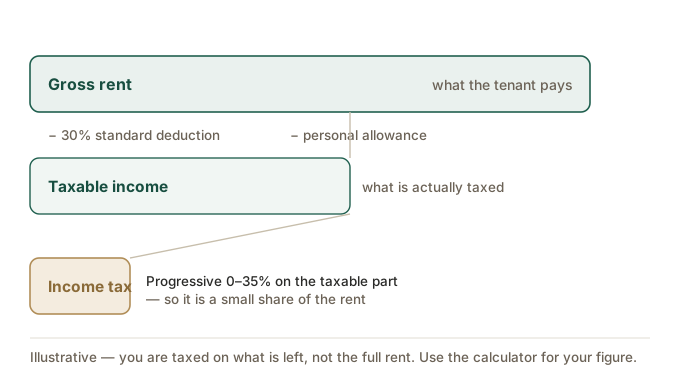
Because of that deduction and the tax-free first band, the effective rate — the tax you actually pay as a share of gross rent — is usually well below the headline brackets. Try your own number:
Rental income tax calculator
Estimate the Thai income tax on residential rental income — gross rent, less the standard 30% deduction and the basic personal allowance, at the progressive rates. Drag to your expected rent.
Annual rent ฿600,000 · less 30% deduction ฿180,000 · less allowance ฿60,000
Estimate, not tax advice. It assumes your Thai assessable income is this rental income, taking the standard 30% deduction and the basic personal allowance. Your real liability depends on other income, residency, actual expenses, any tax treaty, and withholding already paid — confirm with a Thai tax adviser. Ask Estate Asia →
The progressive rates applied to the taxable remainder:
| Net assessable income (THB) | Rate |
|---|---|
| 0 – 150,000 | 0% |
| 150,001 – 300,000 | 5% |
| 300,001 – 500,000 | 10% |
| 500,001 – 750,000 | 15% |
| 750,001 – 1,000,000 | 20% |
| 1,000,001 – 2,000,000 | 25% |
| 2,000,001 – 5,000,000 | 30% |
| Over 5,000,000 | 35% |
If your tenant is a company, it deducts a 5% withholding tax from the rent and remits it for you — this is not an extra cost, it counts toward your final income-tax bill, and you reconcile it when you file. Rent from an individual tenant usually has no withholding, so you declare and pay it yourself.
There is no capital gains tax — but selling has its own costs
Thailand has no separate capital gains tax for individuals — a real advantage over much of the EU. That does not mean a sale is free of tax, though: the cost sits in the taxes the Land Office collects when ownership transfers.
The annual property tax
Thailand’s annual Land and Building Tax is low for residential property — a small fraction of a percent of the government-appraised value, with the lowest rates for a home you live in and modest rates for investment/rental use. For a typical condo it is a minor running cost, not a deal-changer. Rates and the appraisal are set per property, so confirm the current figure for yours.
Are you a Thai tax resident?
You are a Thai tax resident if you spend 180 days or more in Thailand in a calendar year. Residency matters for how foreign income is treated, not for whether your Thai rental income is taxable — rental income arising in Thailand is taxable here regardless of where you live.
A 2024 change means foreign-sourced income earned from 1 January 2024 is taxable when a Thai tax resident remits it into Thailand. This is a changing area, and tax treaties can affect it, so if you also bring money in from abroad, take advice on timing.
Key terms
- Assessable income
- The income actually subject to tax — for rental, your gross rent minus the standard deduction and your personal allowance. The progressive rates apply to this figure, not the full rent.
- Personal income tax (PIT)
- Thailand’s progressive income tax on individuals, running 0% to 35% across bands of net assessable income. Your taxable rental income is taxed under it.
- Withholding tax
- Tax the payer deducts at source and remits for you. When rent is paid by a company (a juristic tenant) it is withheld at 5%; it is not an extra tax — it counts toward your final income tax.
- Capital gains tax
- A tax on the profit when you sell an asset. Thailand has no separate capital gains tax on property for individuals — gains are folded into income tax, and in practice the cost is the transfer taxes at sale.
- Transfer fee
- A one-time fee to register a property transfer at the Land Office — 2% of the official appraised value, customarily split between buyer and seller (often negotiated).
FAQ
How much tax do I pay on rental income in Thailand?
Less than the headline rates suggest. You deduct a standard 30% and your personal allowance first, then pay the progressive 0–35% rates on what remains — so the effective rate on a typical Phuket let is often in the low single digits to around 10%. Use the calculator above for your figure.
Is there capital gains tax on property in Thailand?
No separate capital gains tax for individuals. A gain is not taxed as its own category; instead the Land Office collects transfer taxes (a transfer fee, plus specific business tax or stamp duty, and a withholding tax) when you sell.
What is the transfer fee?
A one-time Land Office fee of 2% of the appraised value to register the transfer, customarily split between buyer and seller (often negotiated). It is the main predictable transfer cost; other sale taxes depend on your holding period.
Do I pay an annual property tax?
Yes, the Land and Building Tax — but it is low for residential property, a small fraction of a percent of the appraised value. Confirm the current rate for your specific property.
Does the 5% withholding on my rent mean I am taxed twice?
No. When a company tenant withholds 5%, that money is paid toward your income tax, not on top of it. You credit it against your final bill when you file, and may get a refund if too much was withheld.
Sources & references
Want your numbers checked?
Tell us about the property and your letting plans, and we will reply within one business day to help you scope the tax picture and point you to a Thai tax adviser where you need one.