
Is it safe to buy property in Thailand? Nominee scams and how to protect yourself
Yes — buying property in Thailand is safe when you avoid nominee structures and use a legitimate ownership path: a freehold condominium unit within the building’s 49% foreign quota, a registered long lease, or a usufruct. The 2026 crackdown on illegal nominee arrangements has raised the stakes for those who cut corners, but independent legal counsel and a proper title search remove most of the risk.
The 2026 nominee crackdown: what changed
In 2026 Thailand stepped up enforcement against nominee property structures — arrangements where a foreigner uses a Thai citizen or a Thai-majority company as a proxy to control land they cannot legally own. Authorities have been scanning company and land records for irregular patterns: multiple companies sharing one address, concentrated shareholding, and Thai "shareholders" whose declared means do not match the assets they nominally hold.
By mid-2026 this was no longer theoretical. The Department of Business Development (DBD) has been running an AI screening system across tens of thousands of company-registration and land records; hundreds of companies have been prosecuted, with the economic damage put in the billions of baht. On Phuket alone several hundred firms were flagged; on Koh Samui and Koh Pha-ngan foreign-shareholding companies number in the thousands — in places a majority of all businesses registered there. One Koh Pha-ngan case in May 2026 ended in an asset seizure worth more than THB 200 million. The shift that matters for buyers: detection and enforcement are now real, not theoretical.
If you hold land through a nominee structure, you are exposed: criminal liability under the Foreign Business Act and the Land Code (imprisonment and fines), a court-ordered forced sale or divestiture of the property, and visa consequences. Where illegally held land is identified, authorities can order it disposed of within a set window — typically 180 days to a year. Since 1 April 2026 the DBD has also tightened company verification: in-person checks, ultimate-beneficial-owner scrutiny, and proof that the Thai shareholders genuinely contributed capital — exactly what a nominee arrangement cannot show. Authorities are studying tougher measures still, including outright forfeiture to the State without compensation — not yet law as of 2026, but a clear signal of direction. None of this touches a buyer who used a legitimate structure from the start — which is the entire point of this guide.
How title-deed fraud works (and how to spot it)
A common scam is a forged or altered land document — selling land that does not exist, or selling the same plot to several buyers, relying on victims not knowing how to verify a deed.
A genuine Chanote (full ownership title) carries physical security features: a watermark visible against the light (the Garuda emblem with "Department of Lands, Ministry of Interior" text), backlit "luminous" points near the corners, and an official signature in black ink under a red government stamp that overlaps the signature. Mismatched ink or a missing stamp is a warning sign.
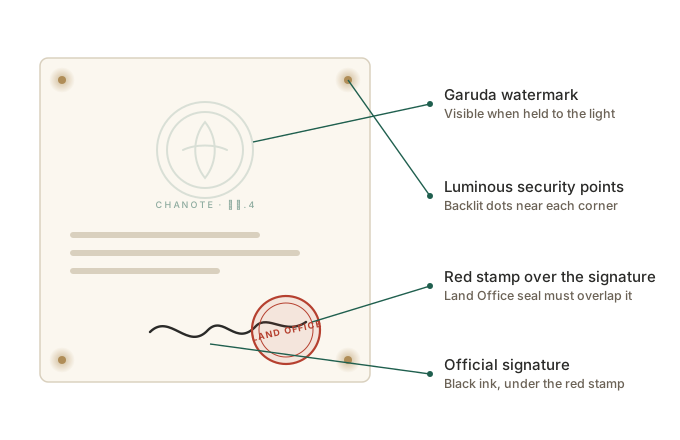
But physical inspection is only the start. Certainty comes from the Land Office: bring the deed and request an official title search against the government registry. If the deed does not match the registry, it is not valid. This is inexpensive and your lawyer can do it before you pay a deposit.
Red flags in off-plan villa & condo deals
Off-plan purchases (buying before completion) are normal in Thailand and can be perfectly safe — if you follow the right steps. Scammers target off-plan buyers because there is a long window before title transfers and buyers are emotionally invested and pushed to pay deposits quickly.
Treat these as red flags:
- Vagueness about paperwork, title deeds, or developer credentials.
- Pressure to pay cash, or into a personal bank account instead of a proper escrow .
- Prices far below comparable units in the same area.
- A "power of attorney" offered in place of a real ownership transfer.
- Refusal to share the developer’s registration details.
- Any push to skip your own independent lawyer.
A legitimate deal survives legal review — that is the test.
What is safe: legitimate ownership structures
There are three solid, legal routes for foreign buyers, each with different trade-offs.
Condominium freehold (within the 49% foreign quota): you own the unit outright on the title deed. A building can be up to 49% foreign-owned by total floor area; once that quota is full, further units are sold on a registered lease. This is the simplest path — full ownership, full resale rights, no expiry.
Registered lease (up to 30 years): you lease the land from a Thai owner with the lease registered on the title, and you own the building. The 30-year term itself is legal and enforceable, but treat any renewal as a fresh negotiation rather than a guarantee — Thai courts do not enforce a pre-agreed automatic renewal beyond the 30-year statutory cap, so continuity past that horizon depends on the landowner agreeing a new lease at the time. This is how most villa buyers hold land — go in planning around the 30-year horizon, not an assumed roll-over.
Usufruct: a registered right to use and enjoy the land, recorded on the title. Granted to an individual, it can run for the holder’s lifetime — the 30-year cap applies to companies, not natural persons — and it ends on death and is not transferable. For an individual foreign buyer, the lifetime usufruct, not a renewable term, is the genuine long-horizon route. All three of these avoid nominee risk entirely.
| Ownership path | Term | Foreign quota | Best for | Nominee risk |
|---|---|---|---|---|
| Condominium freehold | No expiry | Counts toward the 49% cap | Apartments & condos | None |
| Registered lease | 30 years; renewal not guaranteed | Not affected | Villas / land | None |
| Usufruct | Lifetime of the holder (individuals) | Not affected | Individual land use | None |
How to protect yourself: a due-diligence checklist
Before you reserve or pay a deposit, work through this checklist:
- Engage an independent Thai property lawyer — your own, not one the seller recommends.
- Have your lawyer run an official title search at the Land Office and confirm the registered owner matches the deed.
- Verify the developer: company registration, listing status if public, and condominium-project registration.
- Get the ownership structure (freehold, lease, or usufruct) written into the sale-and-purchase agreement before you sign.
- Ask what the building’s current foreign-ownership percentage is — near 49% may mean your unit is offered on a lease, not freehold.
- Confirm funds go to a proper escrow arrangement, not a personal account or a cash deal, and that overseas transfers carry the correct Foreign Exchange Transaction documentation.
Legal due diligence costs money, but on a multi-million-baht purchase it is the cheapest insurance you can buy.
What to do if you already own through a nominee
- Consult a Thai property lawyer now to assess whether your structure is actually illegal and what defences exist.
- Map every shareholder, director, account, and deed tied to the property so your lawyer sees the full picture.
- Where possible, explore regularisation — converting to a legitimate structure, shifting to a registered lease, or selling and re-acquiring as a freehold condo (these steps can carry tax consequences and need legal guidance).
Waiting until enforcement reaches you leaves you with the least leverage.
Key terms
- Chanote (Nor Sor 4 Jor)
- The strongest Thai title deed — full, accurately surveyed ownership. The document you want for a condo unit, or for land held through a legal structure.
- Title search (Land Office)
- An official check of the deed against the government land registry, confirming who really owns the property and that the deed is genuine. Run it before paying any deposit.
- Nominee structure
- An illegal arrangement where a Thai person or company holds property on paper for a foreigner who really funds and controls it, to get around the land-ownership rules. The target of the 2026 crackdown.
- Usufruct
- A registered right to use and enjoy land you do not own. Granted to an individual, it can last their lifetime; it ends on death and cannot be transferred.
- Leasehold
- Holding property under a registered lease rather than owning it. A Thai land lease runs up to 30 years; any renewal beyond that is a fresh agreement, not an enforceable right.
- Escrow
- A neutral third-party account that holds the buyer’s money until the deal’s conditions are met, instead of paying the seller (or a personal account) directly.
- Off-plan
- Buying a property before it is built, from the plans. Usually cheaper, but riskier — title only transfers on completion, which is a long window.
FAQ
Can I legally buy a villa on land in Thailand?
You cannot own land freehold as a foreigner. You can lease the land for up to 30 years (registered on the title) and own the villa on it — that part is legal, common, and safe. Any extension beyond 30 years is a fresh agreement with the landowner, not an automatic right, so plan around the 30-year horizon; for an individual buyer a lifetime usufruct is the alternative long-horizon route.
What is the difference between a lease and a nominee scam?
A registered lease is a legal contract recorded on the official title deed. A nominee arrangement is hidden off the books — a Thai person or company holds title while you fund and control the property. Leases are legal; nominees are not. Always have your structure written down and registered.
Can I use a Thai company to own property if I control the shareholders?
This is increasingly risky in 2026. If the company exists only to get around the foreign land-ownership rules, it is a nominee structure and illegal. A genuine operating business is different. Because hidden foreign control is exactly what enforcement looks for, get legal advice before relying on any company structure.
If the developer handles the paperwork, am I protected?
No. Even when the developer runs the deal you remain responsible for verifying the title and ownership structure. Always use your own lawyer, independent of the developer — their convenience is not your legal protection.
How do I know if a developer is legitimate?
Legitimate developers are properly registered, are often publicly listed if large, and hold buyer deposits in escrow. Ask your lawyer to verify the developer’s registration and project details before you pay anything.
What if the Land Office search does not match my deed?
A mismatch means the deed is likely forged or ownership has changed without your knowledge. Do not sign anything. Have your lawyer petition the Land Office to confirm the true registered owner before you go further.
Is buying resale safer than off-plan?
Resale units have an existing title that is easier to verify, but cost more; off-plan is cheaper but carries more risk over the longer window to completion. Both are legal — off-plan simply demands stricter due diligence and proper escrow.
Does buying through Estate Asia protect me from scams?
Estate Asia flags developers and listings with a trust overlay to reduce your risk, but it is not a substitute for your own lawyer. We pre-filter; your lawyer is your real protection. You should still run an independent title search before you buy.
Sources & references
- Thai Examiner — 2026 nominee-shareholding crackdown (Phuket)
- Bangkok Post — nominee crackdown, foreign buyers pause on villas
- Nation Thailand — nominee crackdown and property-law loopholes
- Global Law Experts — protecting foreign owners after the 2026 nominee crackdown
- Genie Property — how to check for fake title deeds
- Siam Legal — title-deed search in Thailand
- Department of Lands, Thailand (official title & registry)
Talk to Estate Asia
Tell us about the property you are considering — the area, the developer, what you are unsure about. We will reply within one business day to help you plan the right checks.